Most homeowners know that double or triple glazing improves insulation. Fewer know that the component sitting between the panes of glass plays a critical role in how well that glazing actually performs. The spacer bar is one of the most overlooked parts of a window, but it has a direct impact on heat loss, condensation, and overall U-value.
What a spacer bar does
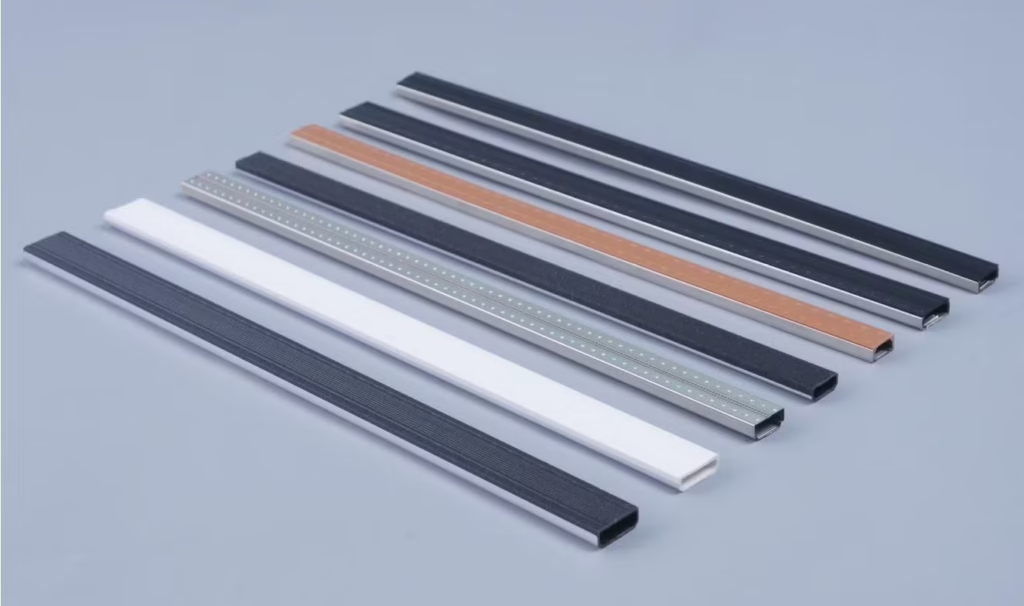
A spacer bar is the strip that runs around the perimeter of a sealed glazing unit, holding the panes of glass apart at a precise, uniform distance. The gap it creates is filled with an insulating gas, typically argon, which slows heat transfer between the inner and outer panes. The spacer also contains a desiccant material that absorbs any residual moisture inside the cavity, keeping the glass clear over time.
In short, the spacer bar defines the structure of the sealed unit. Its material, design, and thermal properties all influence how the glazing performs at its most vulnerable point: the edge.
The problem with traditional aluminium spacers
For many years, aluminium was the standard material for spacer bars. It is strong, easy to manufacture, and structurally effective. However, aluminium is also highly thermally conductive. Heat travels through it easily, creating a thermal bridge at the edge of the glass where the spacer sits.
This thermal bridge causes the internal glass surface temperature to drop significantly at the perimeter. When warm, moist indoor air meets that cold edge, the result is condensation. In severe cases, persistent edge condensation can lead to mould growth, damage to window reveals, and degradation of the sealed unit itself. The cold edge also reduces the effective U-value of the window, meaning more heat is lost through the glazing than the centre-pane figure alone would suggest.
How warm-edge spacers solve this

First, the risk of condensation at the glass perimeter is substantially reduced. Independent testing has shown that warm-edge spacers can improve internal edge temperatures by up to 65% compared to aluminium, and reduce condensation occurrence by as much as 70%. Second, the overall U-value of the window improves. Depending on the glazing configuration, warm-edge spacers can improve the whole-window U-value by between 5% and 18%, a meaningful gain that contributes directly to energy performance and BER outcomes.
Why it matters for your home
In Ireland’s damp, mild climate, condensation around window edges is a common complaint, particularly in kitchens, bathrooms, and bedrooms where humidity levels are higher. Many homeowners assume this is simply a feature of living in a wet climate, but in most cases it is a symptom of poor edge-of-glass performance. Upgrading to windows with warm-edge spacer technology addresses the root cause.
For anyone considering double or triple glazing, the spacer bar specification is worth asking about. It is not always highlighted in quotes, but it makes a real difference to comfort, maintenance, and long-term glazing performance.
A detail that matters at Fairco
At Fairco, warm-edge spacer technology is part of how we approach glazing specification as a complete system. Combined with low-emissivity coatings, gas-filled cavities, and precision manufacturing, every component works together to deliver consistent thermal performance across the full window, not just at the centre of the glass.
If you would like to understand more about how glazing specification affects your home’s comfort and energy performance, book a free consultation or visit our showrooms to discuss your options with the Fairco team.